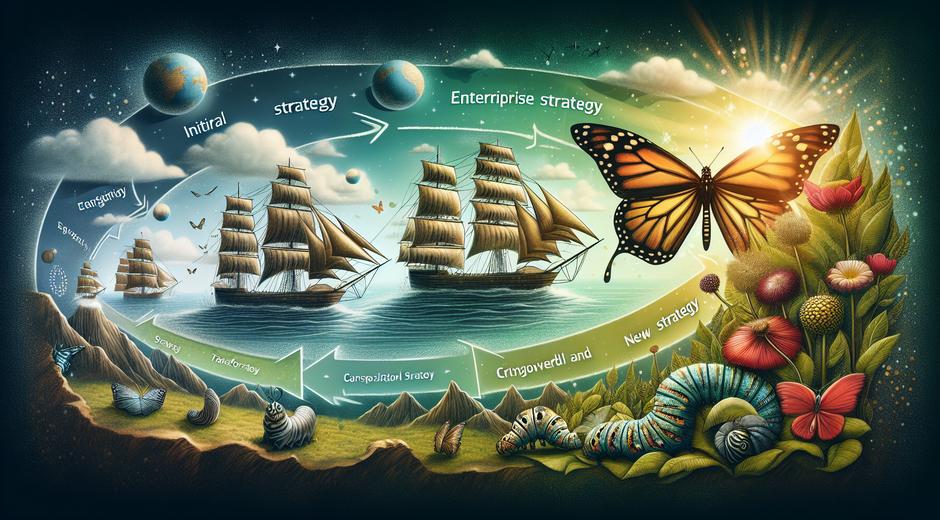


Enterprise Strategy Shifts: How Leaders Can Reposition Their Organizations for Sustainable Growth
Enterprise Strategy Shifts are more than a series of tactical changes. They are deliberate moves by leadership to realign resources people processes and culture with evolving market realities. In an era of rapid technological progress shifting customer expectations and intense competition the ability to plan and execute meaningful Enterprise Strategy Shifts is a core competency for market leaders. For ongoing insights into business trends and frameworks visit businessforumhub.com to explore practical guidance and case studies.
Why Enterprise Strategy Shifts Matter Now
Markets no longer reward incremental improvement alone. Disruption from new business models and new technology often makes legacy approaches obsolete in a short time frame. Enterprise Strategy Shifts enable organizations to pivot from maintenance mode to growth mode by prioritizing initiatives that drive customer value accelerate time to market and create scalable cost structures. When executed well these shifts preserve competitive advantage and open new revenue corridors.
Leaders who treat strategy as a living active discipline rather than a static annual plan are able to identify inflection points sooner. Enterprise Strategy Shifts create clarity for investment decisions and reduce wasted effort by aligning teams behind shared measurable goals.
Key Drivers Behind Enterprise Strategy Shifts
There are common catalysts that prompt enterprises to change course. Understanding these drivers helps leaders design shifts that are proportionate and effective. The most frequent drivers include changes in technology regulatory shifts evolving customer needs partner ecosystem evolution and new competitor models. A diagnostic review will reveal which drivers are most relevant and what degree of response is required.
Another important driver is cultural readiness. Organizations with adaptive cultures learn faster from experiments and scale successful pilots into new operational norms. Building that culture is itself a strategic priority when planning an Enterprise Strategy Shift.
Design Principles for Effective Enterprise Strategy Shifts
Successful shifts follow a set of design principles that keep execution focused and measurable. First be explicit about the strategic intent. Define what success looks like in terms of customer outcomes market position and financial performance. Second prioritize initiatives that unlock leverage. Seek ideas that deliver disproportionate impact for a given investment in time and money. Third create short feedback loops. Rapid iteration reduces risk and surfaces learnings quickly.
Fourth invest in capability building. Whether it is data analytics modern product management or channel partnerships a shift often requires new skills. Commit resources to training hiring and vendor relationships to accelerate capability uptake. Fifth ensure governance and metrics are aligned. Governance structures that enable empowered decisions at the right levels speed progress while preserving accountability.
How to Plan an Enterprise Strategy Shift
Planning a shift requires a sequence that balances analysis vision and action. A practical approach begins with a situational assessment that maps current performance capabilities and external opportunities. Use that diagnostic to craft a focused strategic narrative that explains why the shift matters and how it will be executed. The narrative should be short persuasive and backed by evidence.
Next create a portfolio of initiatives grouped by time horizon. Short horizon pilots validate assumptions medium horizon projects scale proven concepts and long horizon investments secure future options. Assign clear owners and funding envelopes to each initiative. Build an execution cadence with milestones and evaluation criteria so the organization can reallocate resources dynamically based on results.
As part of planning consider the people dimension. Communicate the rationale and expected impacts early and often. Engage managers as change agents equip them with clear talking points and embed new behaviors into performance measures. Leaders should model desired changes and remove blocking constraints that slow adoption.
Tools and Technologies That Support Enterprise Strategy Shifts
Technology is often an accelerant for strategic change. Cloud platforms modern data stacks and automation tools reduce operational friction and enable faster experimentation. Analytics and visualization platforms provide leaders with near real time insights to make course corrections. Workflow tools and collaboration platforms help cross functional teams coordinate work across time zones and organizational boundaries.
When selecting tools prioritize interoperability and ease of adoption. A common mistake is to deploy complex point solutions that create technical debt and adoption drag. Focus first on tools that remove the largest constraints to your planned shift and then expand the toolset as capabilities mature. For design and customer experience trends that can influence product direction you may find curated editorial resources helpful such as StyleRadarPoint.com which tracks human centered trends that intersect with brand and product design.
Measuring Progress and Adjusting Course
Metrics should align directly to the strategic intent of the shift. Leading indicators such as adoption rates conversion metrics and cycle times are more actionable than lagging financial results. Establish a dashboard of metrics that provides early warning and also captures qualitative feedback from customers and frontline employees.
Regular strategic reviews should assess both performance and assumptions. If a pilot fails to achieve expected progress understand why and decide whether to iterate scale or stop. Transparency about trade offs and outcomes builds organizational discipline and reduces sunk cost bias.
Common Pitfalls and How to Avoid Them
Several pitfalls can derail Enterprise Strategy Shifts. One frequent error is the lack of clear prioritization which leads to resource dilution. Avoid this by limiting the number of concurrent strategic bets and protecting those bets with stable funding. Another pitfall is weak change management. Ambiguous communication and lack of role clarity lead to friction and lost momentum. Invest in communication and active manager engagement.
Over reliance on a single technology or vendor can also be a risk. Mitigate vendor lock in with modular architecture and interoperability standards. Finally resist the urge to plan for perfection. Iterative pilots with meaningful evaluation criteria often produce better outcomes than large comprehensive programs launched all at once.
Case Examples and Lessons From Practice
Consider a manufacturing enterprise that shifted strategy to become more service oriented. The firm moved from selling equipment to selling outcomes with performance based contracts. This Enterprise Strategy Shift required new pricing models a field service organization and predictive analytics to guarantee uptime. The firm started with a limited product line and a small customer group to validate the model then scaled as results confirmed the value proposition.
Another example comes from retail where a legacy chain executed a shift to omnichannel commerce. The company reallocated investments from physical expansion to technology logistics and mobile customer experiences. They used short horizon pilots to test click and collect and then scaled operations as processes matured. Both examples illustrate the importance of sequencing capability building with customer focused pilots.
Preparing Your Organization for the Next Shift
Enterprise Strategy Shifts are continuous not episodic. Build a capability for ongoing strategic renewal by embedding planning routines into executive workflows and by maintaining an experimental mindset across the organization. Encourage cross functional teams to submit strategic proposals and create a lightweight funding mechanism to test the best ideas.
Finally cultivate external perspective by listening to customers monitoring competitors and engaging with innovative partners. External signals often indicate where the next shift will be required and early engagement can create partnership opportunities that accelerate success.
Conclusion
Enterprise Strategy Shifts are essential for organizations that want to thrive in dynamic markets. By diagnosing the right drivers using clear design principles investing in capability building and measuring progress with the right metrics leaders can manage risk and capture opportunity. The most successful enterprises treat strategy as an ongoing disciplined practice anchored in customer value and executed with speed and rigor.
If you want to read further on aligning strategy with execution visit our resources at businessforumhub.com for tools frameworks and expert commentary that help leaders implement lasting Enterprise Strategy Shifts.